



What This Page Covers
- What classic Ford F100 truck insurance is
- How coverage differs from standard auto policies
- Key factors like mileage, storage, and usage
- Protection options for restored or modified trucks
- How value is determined for classic vehicles
Why This Matters
- F100s often hold or increase in value over time
- Standard policies may not reflect true vehicle worth
- Proper coverage protects restoration and custom work
- Usage rules can impact eligibility and pricing
- Clear coverage helps avoid surprises during a claim
Key Actions You Can Take
- Get a quote based on your truck’s actual value
- Keep records of restoration and upgrades
- Confirm storage and usage requirements
- Choose a policy built for classic vehicles
- Review coverage for parts and ongoing projects
Classic Ford F100 Truck Insurance
 The Ford F100 truck is a breathtaking model that holds historical significance, and is generally considered one of the best classic trucks of all time among motor enthusiasts. If you’re the proud owner of this landmark vehicle, you need to protect it with the best classic truck insurance available. You can safeguard your cherished ride with Classic Auto Insurance. Our policy coverage includes flexible mileage options, agreed-upon value coverage, spare parts, and other great benefits. Learn more about our affordable and premium coverage by calling 888-901-1338, or get an instant policy quote here.
Ford F100s We Insure
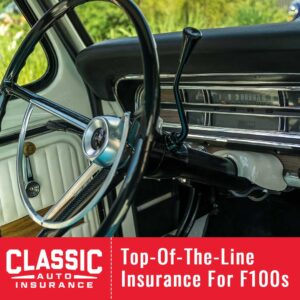
Classic Auto Insurance provides top-of-the-line insurance for a variety of F100s as well as other classic vehicles and older trucks. Some of the classic F100s we insure include:
First Generation
 Ford debuted its F-Series in 1948, making it the first Ford pickup truck available after World War II. This classic truck featured a 226 cu in Flathead 6 engine with a 3-speed manual transmission, producing 95 horsepower. The first-generation F100 was originally called the “Ford Bonus Built.” Ford changed its name in celebration of the brand’s 50th anniversary in 1953.
Third Generation
Ford introduced major styling updates to the F100 for its third generation in 1957, including expanded front-end bodywork and a clamshell-style integrated hood. They also increased the width of its cargo bed, making it a practical choice for hauling. The third-generation Ford was also the first Ford pickup to come with a factory-built four-wheel-drive option.
Fifth Generation
The fifth generation saw major styling updates in 1967, including a square front hood replacing the rounded style, as well as sharper lines and a larger cab. This generation marked an important turning point for the model, as it now came in different trim levels and many powertrain options. Consumers could select the engine and trim level that suited their preference.
How the Ford F100 Became One of the Most Popular Classic Vehicles
 For decades, the Ford F100 was among America’s top-selling vehicles, and it remains one of the most cherished pickup trucks in automotive history.
The F100 has been a top-seller for Ford from the beginning, starting with Ford Bonus Built, which sold 108,000 units in its first year. This number tripled in 1950 due to concerns over the Korean War, because consumers feared Ford would face production restrictions.
Ford continued enjoying tremendous sales with its second-generation F100, which sported a 239 cu in Flathead V8 with 106 horsepower. Its curvy style, incredible craftsmanship, and powerful engine made it a hot seller, further establishing the F-Series as a staple.
In the decades following the second generation, Ford continued refining the F100 across multiple iterations, upgrading its style, comfort, and specifications to continue endearing it to the public.
Ford finally replaced the F100 with the F150 in 1975, but the F100’s rich legacy remains. It’s still widely celebrated as one of Ford’s most important iconic models.
What To Consider When Restoring a Ford F100 and Older Trucks
If you’re interested in restoring a classic Ford F100, understanding the following factors before diving in is important.
Goals
 Consider your overarching goals and intended vehicle usage. Will you use your truck as a daily driver or preserve it for car shows? Your goals and usage impact details such as planning, tools, and design choices.
Budget
Determine your restoration budget and flexibility. This dictates the detail level and whether you should utilize cheaper or premium parts, tools, and components.
F100 Condition
Your Ford’s condition impacts budget usage. You may need to repair its body or prioritize essential components like brakes, suspension, engine, and transmission.
Restoration Accuracy
Determine how close you want your restoration to be to the original factory F100. If you’re sentimental about classic heritage, prioritize factory-correct spare parts and components. If you prefer to customize, get creative with styling and specifications.
Policy Coverage for Classic Truck Insurance
 If you’re the owner of a Ford F100, it’s better to choose classic insurance over standard car insurance, as classic insurers are better equipped to protect rides that are considered classic vehicles. Classic Auto Insurance policies provide exceptional security for collectibles and classics, including the Ford F100. Our classic truck insurance coverage entails agreed-upon value coverage, flexible mileage options, inflation guard, and more, giving you the peace of mind you deserve.
Typically, collectible vehicles require longer risk assessment periods to ensure proper coverage limits that match their unique value. The likelihood of qualifying depends on submitting accurate information. You can discuss details regarding your F100 and our insurance policies, including previous insurance claims for damages, loss history, your driving history, and deductibles, with an insurance agent today. Call 888-901-1338, or receive an instant policy quote by submitting a request here.
Common FAQs For Classic F100 Truck Insurance
Is a Ford F100 considered a classic or antique for insurance purposes?
Most Ford F100 trucks qualify as classic vehicles due to their age and collectible status, particularly models produced between 1948 and 1975. Depending on the insurer, some may also meet antique classification criteria, which is typically based on age thresholds of 25 years or more.
Can I insure a modified or restomod Ford F100 with agreed value coverage?
Yes, many classic insurers—including specialty providers—offer agreed value coverage for modified or restomod F100s. The value is established upfront based on build quality, components, and market demand, ensuring your upgrades are properly reflected in the policy.
What documentation is required to insure a classic Ford F100?
You’ll typically need photos of the vehicle, details about any modifications or restoration, proof of secure storage, and your driving history. In some cases, receipts or a professional appraisal may also be required to support the vehicle’s agreed value.
Does classic truck insurance cover off-road use or farm use?
Coverage for off-road or farm use is typically limited or excluded under classic policies. These policies are designed for controlled, recreational driving rather than heavy-duty, commercial, or work-related use.
How does mileage restriction impact classic F100 insurance premiums?
Lower annual mileage generally leads to lower premiums, as it reduces overall risk exposure. Classic policies are built around limited use, so staying within mileage guidelines helps maintain both eligibility and cost savings.
Can I use my insured Ford F100 as a daily driver?
In most cases, no. Classic insurance policies typically require that you maintain a separate daily-use vehicle, as F100 coverage is intended for occasional driving, events, and leisure use.
Will my Ford F100 insurance cover spare parts and restoration projects?
Many policies include optional or built-in coverage for spare parts and restoration work. This helps protect valuable components and ongoing projects, though specific limits and conditions will vary by policy.
How do insurance companies determine the value of a vintage Ford F100?
Insurers determine value based on the truck’s condition, originality or modifications, and current market trends. Supporting documentation, such as photos, receipts, or appraisals, is used to establish an agreed value that reflects the vehicle’s true worth.